
No products in the cart.
Return To Shop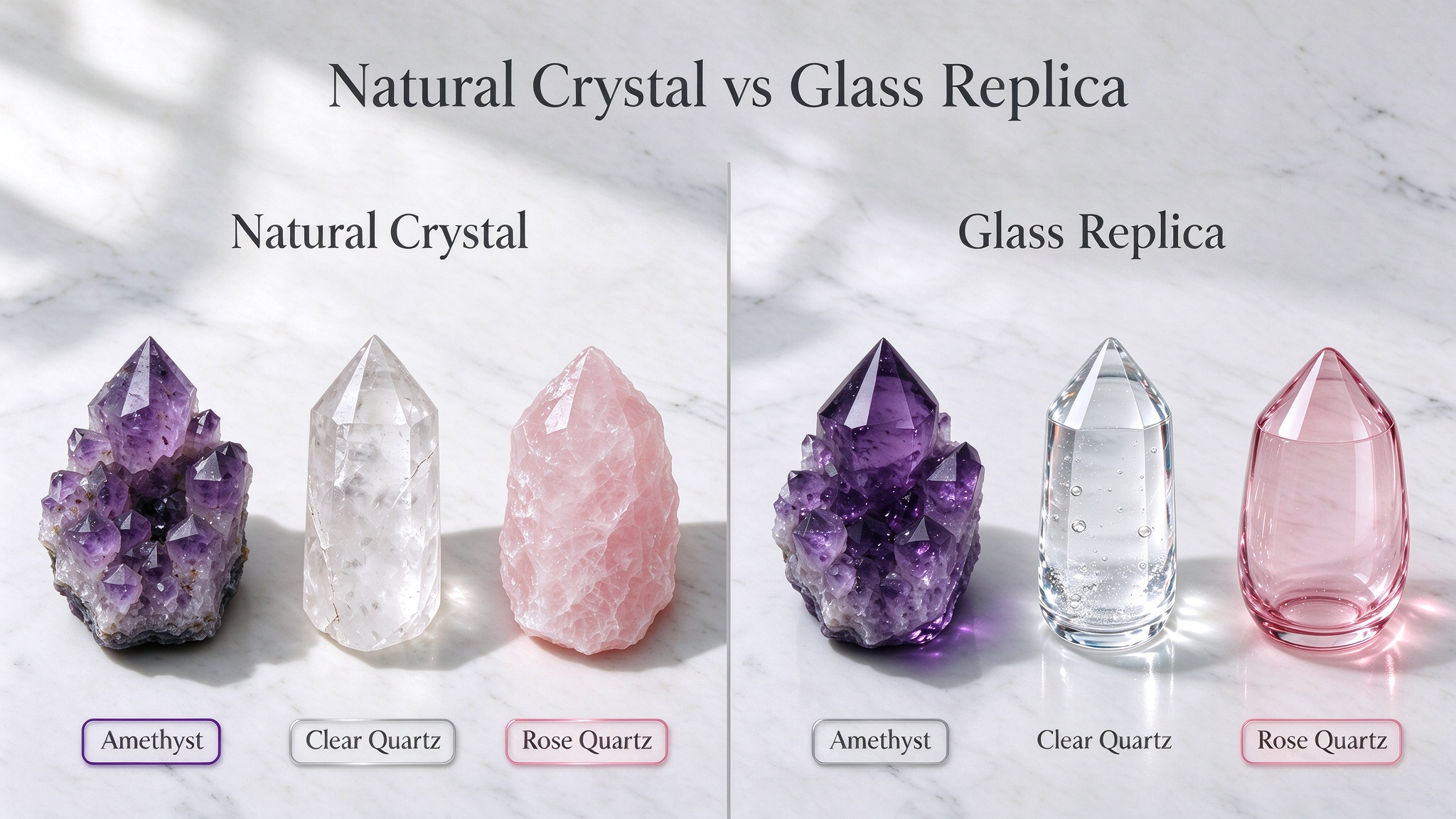
How to Tell If a Crystal Is Real: A Beginner’s Guide
Have you ever seen a beautiful crystal online and wondered whether it looks just as good in real life? Maybe you’ve come across a piece of rose quartz with a lovely pink color or an amethyst that seems almost too perfect to be natural.
If you’re new to crystals, it’s easy to feel unsure about what you’re buying. Some stones look very similar to glass, and product descriptions don’t always explain how they were made or treated.
The good news is that you don’t need to be a gemstone expert to shop more carefully. A few simple checks can help you ask better questions and avoid some common mistakes.
What Does “Real Crystal” Actually Mean?
Before trying to identify a crystal, it’s worth understanding what sellers mean by the word real.
Natural crystals, such as amethyst and rose quartz, form through geological processes over time. Synthetic crystals, on the other hand, are grown in laboratories. Some have the same chemical composition as their natural counterparts, even though they were created differently.
Then there are glass imitations, which are made to look like gemstones, and natural stones that have been treated to change their color or appearance.
These aren’t all the same thing. A lab-grown crystal isn’t necessarily glass, and a treated natural stone isn’t automatically fake. The real issue is whether the material is being described honestly.
If you’re paying for a natural stone, you should be able to find out whether it’s natural, synthetic, or treated.
Take a Closer Look at the Color
One of the first things people notice about a crystal is its color. It’s also one of the easiest things to misinterpret.
Natural stones can have subtle variations. Rose quartz, for example, often has a soft, cloudy pink appearance rather than a perfectly even color. Amethyst may show different shades of purple within the same stone.
But don’t assume that an evenly colored crystal must be fake. Some natural stones have a fairly consistent appearance, while dyed stones can have irregular patterns that look surprisingly natural.
Color is a useful starting point, but it can’t tell you the whole story.
What Can You Learn from the Inside of a Crystal?
Sometimes, the most interesting details are inside the stone rather than on its surface.
Under good lighting, you might notice tiny fractures, cloudy patches, or small inclusions. These features can occur naturally as a crystal forms. Glass may contain round gas bubbles, which can be a clue that the material isn’t a natural gemstone.
Still, it’s easy to draw the wrong conclusion from a photograph. Some natural stones are remarkably clear, and not every round-looking feature is a bubble.
If you’re shopping online, look at several photos rather than relying on one close-up. When the material is expensive or the listing makes strong claims about authenticity, it’s worth asking for more information.
Can You Tell If a Crystal Is Real by Touching It?
You’ve probably heard that real crystals feel cool to the touch. There’s some reason this idea persists: different materials transfer heat differently, so they can feel different against your skin.
However, this isn’t a reliable way to identify a natural crystal. Room temperature, stone size, and the material itself can all affect how it feels.
The same goes for scratching a stone to test its hardness. Even if a test reveals something about the material, it may leave permanent damage without confirming exactly what the stone is.
I’d avoid these home tests, especially on jewelry or a piece you want to keep looking beautiful. Careful observation and reliable seller information are much safer places to start.
When a Crystal Seems Too Cheap to Be True
Price isn’t proof of authenticity, but it can be a reason to look a little closer.
Imagine finding a large, perfectly clear gemstone advertised as a rare natural crystal for a surprisingly low price. Before getting excited, read the description carefully. It could be glass, a lab-grown material, a treated stone, or simply a different mineral from the one you expected.
That doesn’t mean inexpensive crystals are always fake. Smaller stones and more common varieties can be affordable, and prices vary widely with quality and size.
What matters is whether the price makes sense for the product being advertised.
A trustworthy seller should be able to explain what the stone is, whether it has been treated, and what information supports those claims. For a valuable gemstone, an independent gemological assessment is a much better option than guessing from a photo.
Not Every Natural Crystal Is Untreated
This is something beginners often overlook.
A stone can be natural and still have been changed after it was mined. Heating, dyeing, and other treatments are used in the gemstone trade to alter color or appearance.
Amethyst, for instance, can be heated to produce yellow or orange tones associated with citrine. Other stones may be dyed to create a more vivid color.
Treatments aren’t automatically a bad thing. Some people are perfectly happy with treated gemstones, while others specifically want untreated material. Neither preference is wrong.
The important part is knowing what you’re getting. If untreated stones matter to you, ask the seller directly instead of relying on the product name alone.
Buying Crystals Online? Look Beyond the Photos
A crystal can look completely different depending on the lighting. Warm light may make a pale stone appear pinker, while editing can make purple or green colors look much more intense.
This is why I wouldn’t choose a crystal based on its main product photo alone.
Take a moment to check the other images, read the description, and see whether the seller explains the material clearly. Customer photos may also help you understand what the item looks like outside a carefully arranged product shoot.
And don’t forget the return policy. If the stone arrives looking very different from what was advertised, you’ll want to know what options you have.
A little research before buying can save you disappointment later.
Does a Crystal’s Meaning Matter More Than Its Authenticity?
For some people, crystals are mainly beautiful natural objects. Others enjoy the stories and symbolism associated with them.
Rose quartz is commonly linked with love and affection, while amethyst is often associated with calmness and wisdom in modern crystal traditions. These meanings can make a stone feel more personal, especially when it’s chosen as a gift.
Of course, symbolic meanings aren’t scientifically proven effects. And a crystal doesn’t have to be rare or expensive to be meaningful to the person who owns it.
If you’re interested in what different stones represent, take a look at our guide to 7 popular crystals and their meanings. If you’re choosing a present, our article on crystal bracelets for gifts may also give you a few ideas.
A Few Things to Remember Before You Buy
There’s no single visual trick that can tell you whether every crystal is genuine. Color, inclusions, temperature, and price can all offer clues, but none is conclusive on its own.
When in doubt, focus on what you can verify. Read the description, ask questions, and choose sellers who are open about their products. For valuable stones, professional identification is worth considering.
Most importantly, take your time. You don’t have to know everything about crystals before buying your first one. Learning to recognize good information—and knowing when to ask for help—is already a good start.

About author


Add comment